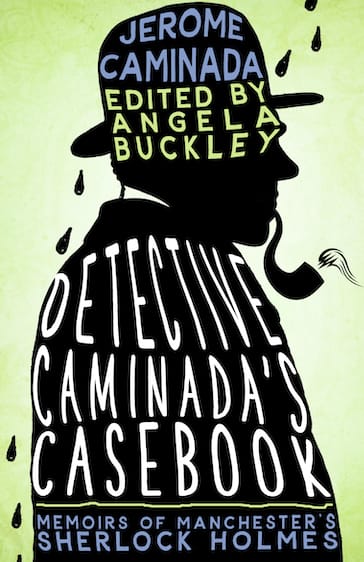
When I came across the pioneering detective, Jerome Caminada, whilst researching my family’s roots in Manchester, I immediately bought a copy of the first volume of his memoirs, which was published in 1895 (this was the start of my detective autobiography collection!). His casebook is absolutely fascinating but, with over fifty chapters in typical nineteenth century police officer style, his tales of life on the beat can be quite hard to read. So, I decided to make my own selection of his best stories to share with 21st century true crime fans like me.
I chose twenty-three of my favourite cases, which I edited (removing some of the extraneous and irrelevant content), and published them. I’ve recently updated the collection by adding notes. Detective Caminada’s Casebook offers a glimpse into the everyday sleuthing work of one of the finest investigators of Victorian Manchester and to celebrate the new edition, I’d like to share summaries of three cases: his first experiences as a constable, his undercover work at race meetings, and a strange encounter with a ‘ghost’.
Caminada’s first week on the beat
When Jerome Caminada joined the Manchester City police force in 1868, at the age of 24, his expectations were high but he was soon brought back down to earth. On a freezing cold night with snow on the ground, as he picked his way along the slippery pavements of John Dalton Street in the pale, yellow light of the gas lamps, a man called out to him. When Caminada turned to face him, he was assailed by a tirade of insults. Before the young officer had a chance to respond to this unprovoked attack the man, a beerhouse keeper named Quinn, punched him in the face before fleeing the scene.
‘I was certainly a little non-plussed,’ Caminada recollected, ‘To get a violent blow on the nose…was not a very pleasant experience for a beginner.’ Undeterred, he returned to his business of pacing the beat, but as he reached the corner of the street, he suddenly received another thump from Quinn, this time to his ear.
Still smarting from the blow, Caminada pursued the beerhouse keeper as he took off into the night. Quinn flew up a flight of stairs in a nearby tavern, but Caminada grabbed his legs and dragged him back down to the pavement. A scuffle ensued, which resulted in Quinn biting the policeman’s hand ‘in right good fashion’. Luckily the injury wasn’t as serious as it might have been:
Fortunately, he had no teeth, but he worked away so vigorously with his gums that I could feel the pain for weeks after.
Quinn was convicted of assault and Caminada never forgot his first incidence of violence on the streets: ‘Though the matter was no joke at the time, I often smile when I come across my friend, the beerhouse-keeper, Quinn.’

Caminada in disguise
In his first years as a police officer, Detective Caminada was often instructed to go on duty at racecourses, where he and his colleagues would scan the crowds of pickpockets and con artists. They would travel by train to public race meetings, such as at Aintree, and carry clothing in a bag ready for disguising themselves (admittedly, this seems a little odd as they were already in plain clothes!). On one occasion, Detective Caminada’s undercover outfit caused considerable confusion and was so convincing that he even deceived the chief constable.
At the Grand National one year, Caminada was detailed to take charge of the grandstand and, while he was inspecting the arena, he saw three men, dressed as ‘swells’ (respectable gentlemen), trying to pick the pocket of an elderly gentleman. He signalled to his colleagues to go undercover and they quickly slipped into a field and disguised themselves as labourers. Before long, the thieves tried to fleece another gentleman – one put his hand on the victim’s shoulder to steady himself while he peered over the heads of the crowd, apparently looking for someone, while his accomplice unbuttoned the man’s overcoat with lightning speed and felt his pockets. This time they didn’t find anything so they separated and moved on into the crowd near the grandstand.

Their next ‘mark’ was another gentleman who had carefully buttoned both his overcoat and undercoat after placing his wallet in his inside pocket. The daring thief unbuttoned both coats, detached the chain from the man’s watch, drew it out and passed it to his companion who hurried off down the steps where Caminada was lying in wait for him. The detective rounded up all three, lifting one bodily, and escorted them the short distance to the local police office, where he handcuffed them to a strapping officer in uniform.
Whilst this was going on, the chief constable rushed into the office shouting that he too had been robbed of his pocket watch. Forgetting that he was still in disguise, Caminada took out a watch that he’d recovered from the thieves and showed it to the superior officer who, much to the amusement of everyone present, immediately began to interrogate him. Caminada maintained his sangfroid as he explained the situation. He recalled in his memoirs rather smugly:
This story shows that even responsible officers of police sometimes become as easy prey to thieves as other people.
Caminada’s ‘ghost’
Following complaints made at the Manchester detective office, from a local business, who sold sheet music, Detective Caminada set out to investigate the strange case of the missing scores. Every concert night at the Free Trade Hall, sheets of music disappeared during the performance and no clues could be obtained as to the identity of the thief. After a rather fruitless search, Caminada arranged with the firm to have a large piano box made with holes in so he could hide inside and watch what was going on. He had the custom-made box delivered to the venue and, on the evening of the next concert, he climbed inside with ‘no one having the slightest knowledge of its unmusical contents’. As the opening of the evening’s performance drew near, he watched the hall’s librarian, who was responsible for the music, take his position. The musicians started tuning their instruments and once the final preparations were made, they left for the stage. Only Caminada, concealed in the box, and the librarian remained in the ante-room. The concert began at 7.30 pm and all was well.

Backstage, everything remained quiet until the interval, when once again the ante-room was filled with musicians, bustling about and tuning their instruments. The concert resumed and the room cleared. After about thirty minutes into the second half of the performance, the librarian started looking over the music. Detective Caminada watched as he slipped two sheets of music from the pile and put them into his pocket. However, the detective was still in the box, deciding what to do next now that he’d solved the mystery, when the final curtain went down and the musicians came rushing back into the room. He dared not get out of the box. When they had all gone home, Caminada was scared that he would be left overnight. He called out to the caretaker, who had come to put out the gaslights:
Shift these fiddles from the piano case, man, and let me out. I am no ghost, but flesh and blood like yourself.
With his hair almost standing on end, the man opened the box and the detective emerged from ‘his temporary prison’. As he clambered out, his rescuer, who was in a cold sweat and with ‘all the blood having forsaken his face’, looked more like a ghost than the detective.
My collection of cases from Caminada’s memoirs also includes his accounts of con artists, forgers, a renowned quack doctor, anarchists and his very own nemesis, a notorious burglar and would-be killer. You can find out more here.